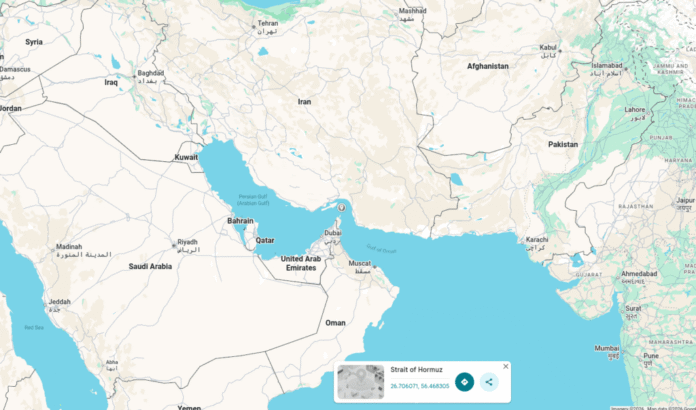
Iran’s grip over the Strait of Hormuz, one of the most important oil maritime transit choke points, remains firm. FT reported last week that Iran intends to charge a toll for passing, and Bitcoin was named the currency of choice. Here’s why this surprising turn of events has been predicted by Bitcoiners for over a decade.
On April 8, FT published a report titled “Iran demands crypto fees for ships passing Hormuz during ceasefire,” except it wasn’t crypto, it was Bitcoin. The report covered developments during the current two-week ceasefire in the war between the United States, Israel, and Iran, specifically over the Strait of Hormuz, which pre-war saw 20% of global oil flow through in tankers, supplying Europe, Asia, and much of the world. Iran as the article stated intents to charge a toll for ships to be allowed passage through Hormuz a key geographic choke point which Iran has tight control over via long range missles, underwater mines and attack drone technologies.
The report included an interview with Hamid Hosseini, a spokesperson for Iran’s Oil, Gas and Petrochemical Products Exporters’ Union, who told FT what oil vessels need to share inventory data with Iran and pay a $1 fee per barril of oil in Bitcoin to be allowed safe passate through Hormuz; “Once the email arrives and Iran completes its assessment, vessels are given a few seconds to pay in Bitcoin, ensuring they can’t be traced or confiscated due to sanctions.”
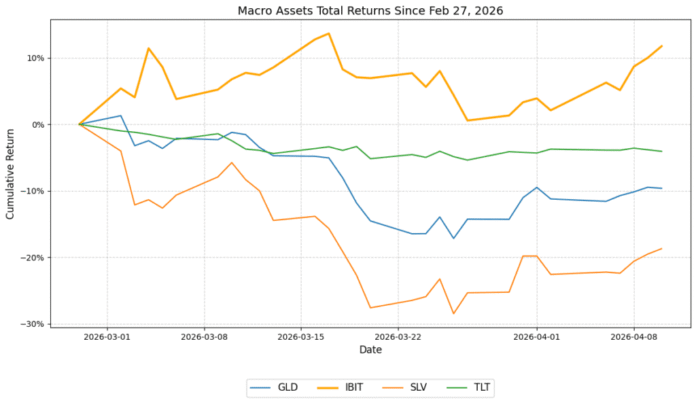
The report shook the Bitcoin community and made international news, as the Bitcoin price rose to $73,000 from the high 60’s. Iran’s choice to demand Bitcoin for safe passage instead of dollars, yuan, or gold is a profound recognition of Bitcoin’s superiority as money in the modern world. It validates decade-old theories by Bitcoiners that Bitcoin is money for enemies, fundamentally neutral, and thus ideal for international trade.
The facts are clear. Iran does not want dollars because the United States has already placed incredibly heavy sanctions on it, cutting it off from Western payment rails. Iran does not want the Chinese currency either, as it would become dependent on yet another major power, giving up its sovereignty. Gold would need to be transported somehow, from the ships to Iran, complicating matters or settled via the banking system, resulting in the same sanction risk that fiat currencies pose. Tether gold is not an option either for the same reason: a trusted third party that can be sanctioned holds the shiny rocks; not even the most transparent and cryptographically authenticated “trust me, bro” technology can get around that fact.
Only Bitcoin stands as a viable option to receive payment for a country at war like Iran, as the Bitcoin blockchain is an international network of highly interconnected nodes that resist censorship and thus sanctions by design, allowing quick and secure digital settlement.
Bitcoin acquired by Iran could be stored in multi-signature cold storage, a kind of high-security Bitcoin account that requires multiple keys to sign a valid withdrawal, and probably already does. The keys can be distributed throughout the world or across various bunkers in Iran, making confiscation or destruction of the access keys very difficult. Iran has had a long history with Bitcoin now, reported to have held up to 10% of the total mining capacity of Bitcoin at various times, giving them deep experience using and securing the asset.
Earlier that day, before the FT report even came out, Trump told ABC that a joint venture had been discussed with the Iranian leadership to secure the Strait of Hormuz. “We’re thinking of doing it as a joint venture. It’s a way of securing it — also securing it from lots of other people.” Impling a discussion between the U.S. and the Iranian leadership as peace talks continue and some compromises are explored to re-stabilize the international oil trade.
The Saudis quickly put out a statement, “Allowing Iran any form of control over the strait would be a red line,” said Ali Shihabi, a commentator close to the Saudi royal court, according to The Times of India “The priority has to be unimpeded access through the strait.”
The FT report dropped soon after, followed by a Trump statement shunning the idea of a toll, where he said Iran “Should not charge fees”. He added that “There are reports that Iran is charging fees to tankers going through the Hormuz Strait — They better not be and, if they are, they better stop now!”
But will Iran roll back the toll of Hormuz, and why would they?
Given the state of the conflict and dramatic collapse in international relations between the warring nations, Hormuz stands as the biggest advantage Iran has in the conflict. The Iranian regime has proven its resilience despite extensive bombardment of its military infrastructure and multiple assassinations of its leadership. Meanwhile, they continue to demonstrate long-range weapons capabilities with which they can block passage through Hormuz. The cost of these long-range weapons is far lower than the cost of the missile interceptors required to protect the oil tankers attempting to cross, and in war, economics matter a great deal.
Trump acknowledged this fact in a press conference where he said that one Iranian with a machine gun is enough to block safe pasage; “Look, problem with the strait, a guy can take a mine, drop it in the water and say, ‘oh, it’s unsafe’… Or you can take a machine gun from the shore and shoot a few bullets at a ship, or maybe an over-the-shoulder missile, small missiles.” he told CBS earlier in the month.
The cost of attacking ships that go through the strait is far lower than the cost of defending them. Short of a much larger military escalation, there’s actually surprisingly little that the United States can do from a military perspective to secure the strait. In theory, the U.S. could win this war against Iran, but at what cost? Genocide perhaps, or boots on the ground and a full invasion? Ultimately, the U.S. could go as far as nuking Iran, but what consequences would any of those options have for the U.S.’s international relations, or the midterms, which republicans are expected to lose as it stands? The political costs could be too large. And the next regime to take hold in Iran would know that at any point, they could try the same Hormuz gambit.
The only long-term solution to this conflict is likely to be diplomacy, and the leverage Bitcoin gives to Iran as a sovereign nation’s sanction-resistant money will play into the negotiations. Especially if Bitcoin lets Iran monetize the toll of Hormuz.
What happens next?
If the toll of Hormuz stands and is not defused by either diplomacy or total war, then oil tankers looking to pass will need to acquire Bitcoin in the millions of dollars per ship. But that is easier said than done, since basically every Bitcoin exchange in the West is sanctioned from doing business with Iran, so shipping companies would have to acquire it from jurisdictions that allow it, likely in the East. There they could make a fiat payment to some exchange in China or Russia, perhaps, buy the Bitcoin and send it to Iran for the toll. This will increase demand and thus the price for Bitcoin in the east, making mining more profitable, which would in turn balance the hashrate distribution, which over recent years has concentrated in the United States.
China and Japan are some of the largest beneficiaries of the oil that passes through Hormuz, as is Europe, so all these nations now have an added incentive to not just facilitate Bitcoin trade at a corporate and national level, but also to acquire mining hardware, as it is fundamentally the only way to guarantee their transactions go through.
If the United States chooses to, it could try to coerce large Bitcoin miners into trying to censor Bitcoin transactions that pay for the Iranian toll, but that too will fail as long as there’s enough eastern hash rate, and the economic incentives in this case seem to favor the east.
Editorial Disclaimer: We leverage AI as part of our editorial workflow, including to support research, image generation, and quality assurance processes. All content is directed, reviewed, and approved by our editorial team, who are accountable for accuracy and integrity. AI-generated images use only tools trained on properly licensed material. In Bitcoin, as in media: Don’t trust. Verify.